Here is a video about some of the common mistakes we see learners make. It’s not “how to tie a knot,” but rather some of the other steps in the process. It’s not exciting. It’s a little too long. I get it, but I bet there is something in it that you didn’t know you didn’t know.
Continue readingUncategorized
Procedural Sedation Checklist
You only need one sedation to go awry to realize that this is an area where an ounce of prevention is worth a pound of cure. We have an informal checklist you should use to make sure you have thought of every potential complication and planned for it accordingly. This particular checklist was made in-house and has not been formally validated. However, it was made after reviewing similar checklists from other departments, and it has been approved by our ED staff as well as anesthesia. Use it. It wards off evil spirits.
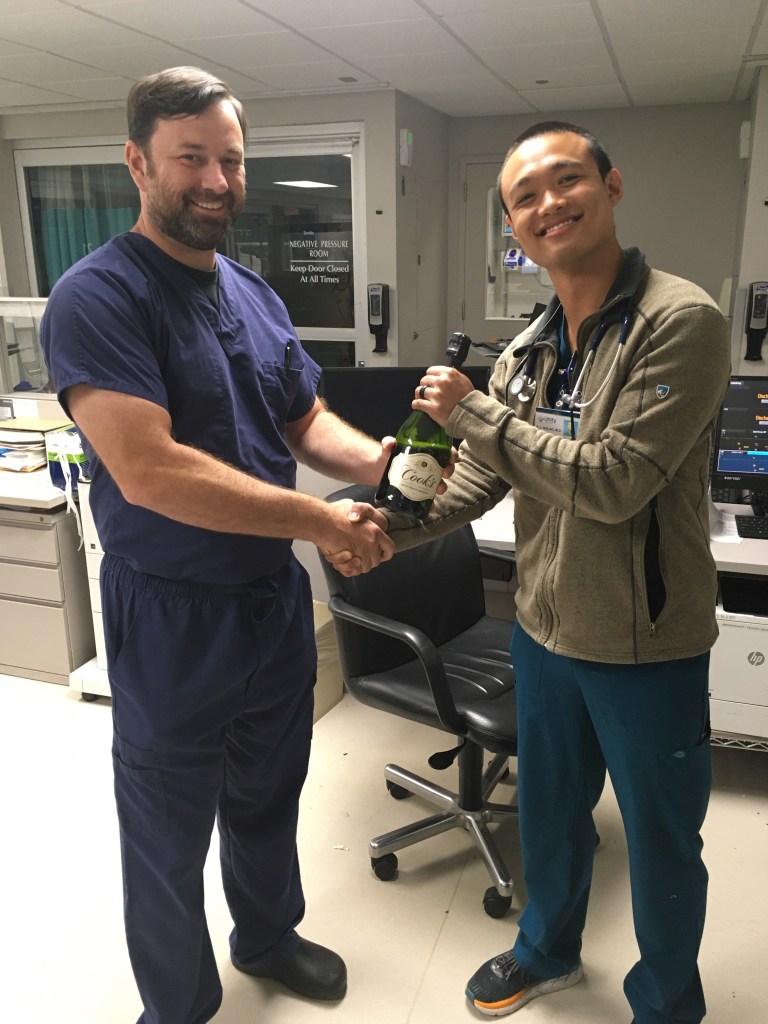
Continue readingNew member of the club
Median Nerve Block
One of the interns did this fantastic block. There are lots of examples of good technique here.
Continue readingSTEMI
The formal definitions of a STEMI are the following:
New J point elevation, in the absence of LBBB and LVH of:
- Greater than or equal to 1 mm in at least 2 contiguous leads EXCEPT leads V2 and V3
- Leads V2-V3 require:
- greater than or equal to 2.5 mm in men less than 40
- greater than or equal to 2 mm in men over 40
- greater than or equal to 1.5 mm in women
- Inferobasal STEMI’s (previously known as posterior infarcts):
- Isolated ST depression greater than or equal to 0.5 mm in leads V1-V3
- especially when the terminal T wave is positive
- If these are present, STEMI is confirmed by STE in posteror leads (V7-V9), which should be obtained:
- STE greater than or equal to 0.5 mm or
- STE greater than or equal to 1 mm in men < 40
- Reference:
- Govea A, et al. Interv Cardiol Clin. 2021 Jul;10(3):293:306.
Here it is.
I’ve spent a lot of time trying to find a way to get info out to all of the residents in a format they can find easily. Here it is.
My hope is to simply have a place with “how to” information: how to use qpath, how to meet the sepsis measure, how to remember all of the educational stuff we have accumulated – atomizers for example – I bet you didn’t know we had those.
I’ll get all that on here and anything else that we might find necessary.
It’s going to be epic.
 Searcy EM