I saw a 51-year-old man recently with hypotension and tachycardia. It got interesting.
Continue readingCardiology
What’s the heart rate: follow up
In the last post, I mentioned that I was not sure why there was no palpable pulse from the PVC during ventricular bigeminy. Does the PVC not cause a mechanical contraction at all? Or does it actually cause a contraction that is too weak to feel? I’d mentioned that I could have answered the question with an ultrasound.
It was just a matter of time before this happened again.
Continue readingWhat’s the heart rate?
Here we see a nice example of ventricular bigeminy. Besides the rhythm, do you notice anything strange on the cardiac monitor?

Do the details matter?
Navigating High Sensitivity Troponin Testing: Guidelines, Protocols, and Insights
Our hospital switched to a high sensitivity troponin several months ago. We were given a protocol to use that is a little confusing, so I spent an absurd amount of time reading guidelines to figure out how to safely use this test. This is what I found.
Continue readingProbe Orientation in Cardiac Ultrasound
Learners often struggle with which direction to point the probe marker when scanning the heart. Hopefully this is a quick fix.
Continue readingRegional Wall Motion Abnormality
A 45 year-old man presents by EMS after a VF arrest. On arrival at the ED he has a pulse. An ECG shows an anterior STEMI. The cath lab is activated and the cardiologist is en route. While waiting for the cavalry to arrive, you ultrasound his heart and strike gold.
Continue readingECG Brain Buster Hints
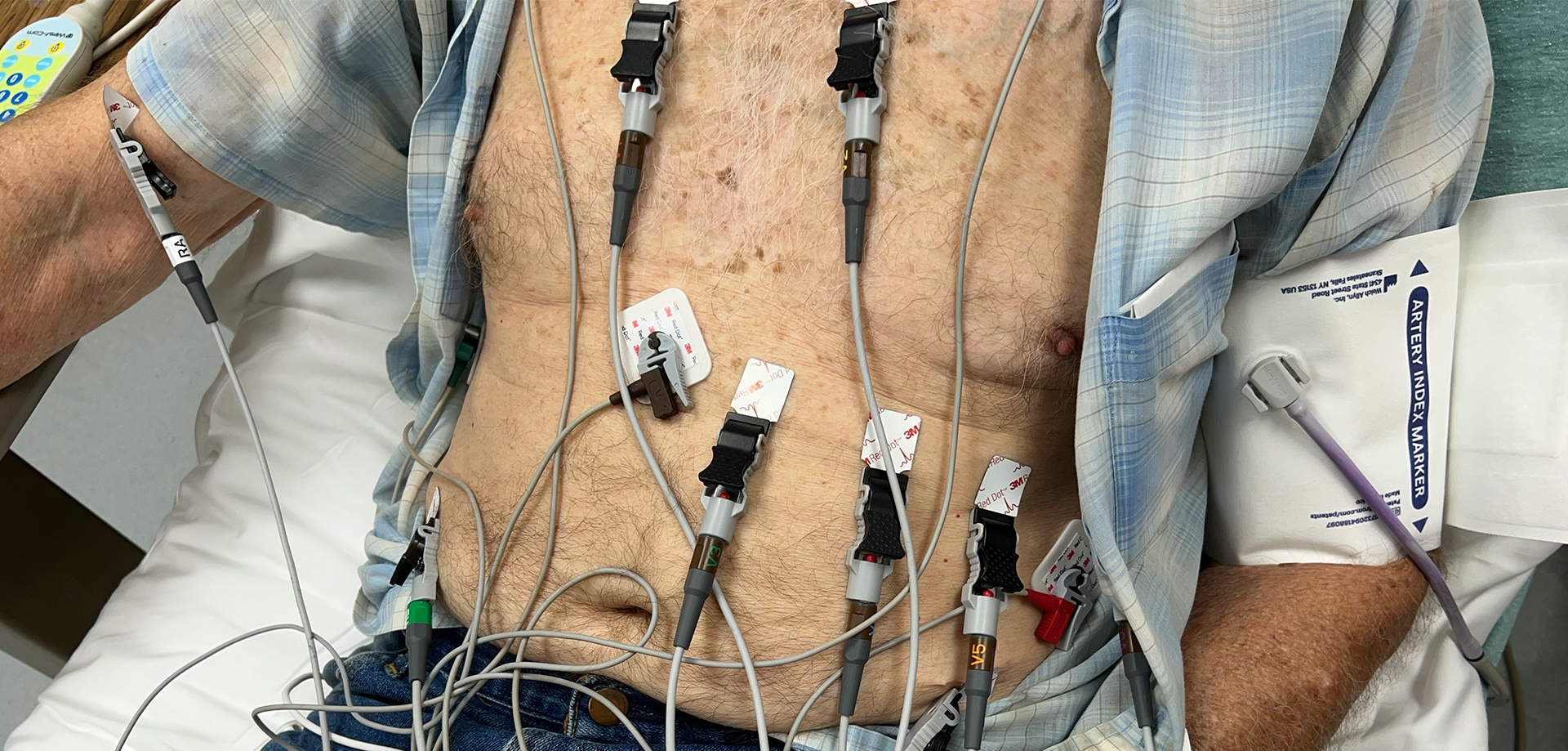
Two brave souls took a stab at it. Both accurately found that number 3 was the one with the leads in the correct places. Both had other things correct as well. Neither had all of the answers. To finish it up, I’ll give you some food for thought and see if anyone can put it all together.
Continue readingIs this a STEMI? – answer

EKG answer
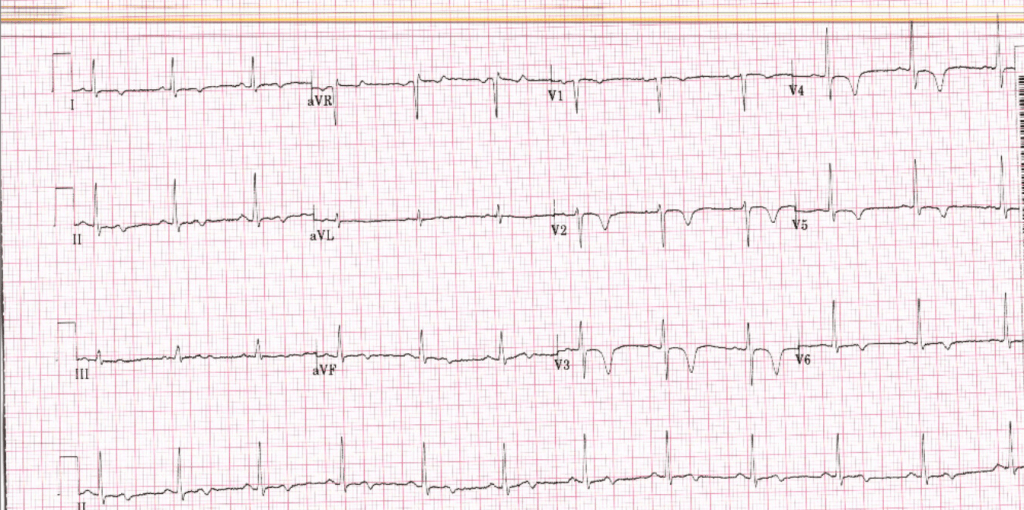
Wellens’ syndrome it is. (For completeness sake, Dr. Wellens has an “s” a the end of his name – it is not “Wellen’s syndrome” it is “Wellens’ syndrome.” And, whether one should use the apostrophe or not with an eponymous syndrome is debatable. Some sources omit it completely: “Wellens Syndrome” but not “Wellen syndrome” – I feel better now that that’s off my chest.)
Continue reading Searcy EM