Bones are very echogenic, which makes their ultrasound appearance a bright white line that is often easy to see – particularly in the case of superficial long bones. That’s what makes ultrasound a great way to find fractures. Let’s look at some examples.
Continue readingAuthor: Jeffery Steele
What’s the heart rate: follow up
In the last post, I mentioned that I was not sure why there was no palpable pulse from the PVC during ventricular bigeminy. Does the PVC not cause a mechanical contraction at all? Or does it actually cause a contraction that is too weak to feel? I’d mentioned that I could have answered the question with an ultrasound.
It was just a matter of time before this happened again.
Continue readingWhat’s the heart rate?
Here we see a nice example of ventricular bigeminy. Besides the rhythm, do you notice anything strange on the cardiac monitor?

Do the details matter?
Navigating High Sensitivity Troponin Testing: Guidelines, Protocols, and Insights
Our hospital switched to a high sensitivity troponin several months ago. We were given a protocol to use that is a little confusing, so I spent an absurd amount of time reading guidelines to figure out how to safely use this test. This is what I found.
Continue readingWhat’s wrong with these ECGs?
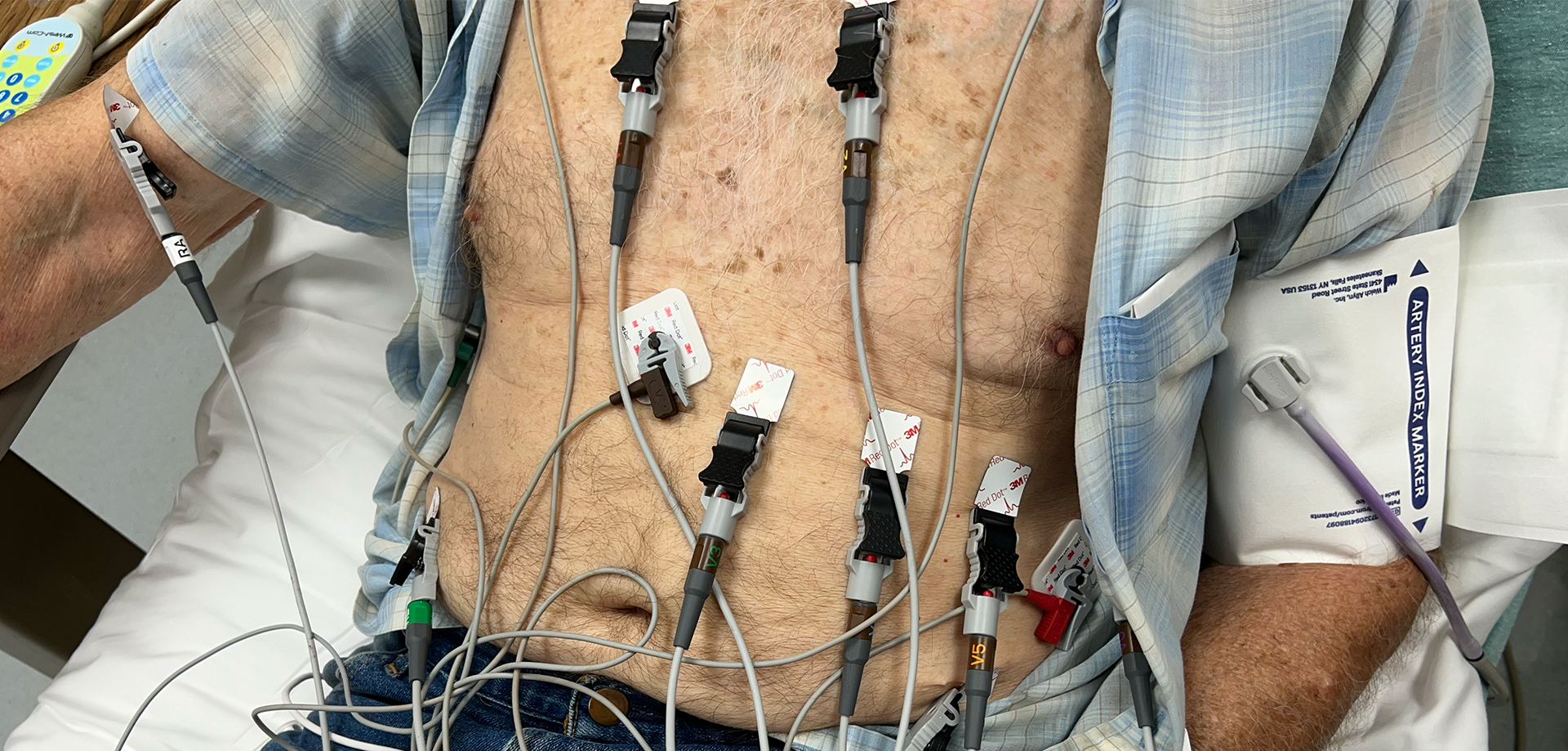
We had something come up twice over the past month or so with our ECGs. Several of the residents had trouble spotting the issue. I bet they were not the only ones. Can you see the problem?
Continue readingProbe Orientation in Cardiac Ultrasound
Learners often struggle with which direction to point the probe marker when scanning the heart. Hopefully this is a quick fix.
Continue readingKindergarten Capnometry
Regardless of your opinion on its necessity, the first step in putting end-tidal CO2 to use is understanding what it is. Here are the basics.
Continue readingTighten the screws on your lung ultrasound
Lung ultrasound is quick, easy, and very helpful in a patient with undifferentiated shortness of breath. There are, however, a few subtleties that I often see learners not grasp. Let’s clear it up.
Continue readingHow much calcium was that?
When we need to give intravenous calcium for hyperkalemia, we generally have two options: calcium chloride and calcium gluconate. We think of calcium chloride as being “stronger,” but what exactly does that mean? Let’s look at.
Continue reading
