In the last post, I mentioned that I was not sure why there was no palpable pulse from the PVC during ventricular bigeminy. Does the PVC not cause a mechanical contraction at all? Or does it actually cause a contraction that is too weak to feel? I’d mentioned that I could have answered the question with an ultrasound.
It was just a matter of time before this happened again.
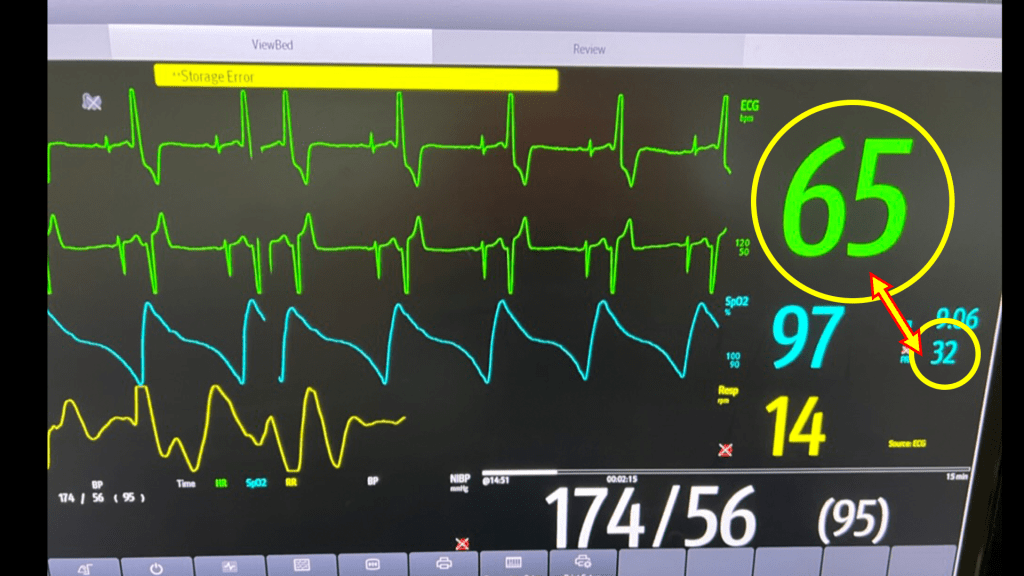
This time I made sure to get the echo images that I didn’t think to get last time.
…And for good measure, I got a spectral Doppler tracing of flow through the carotid artery to see if there were two separate measurable movements of blood.
This is what I found.
Parasternal Long Axis of a patient in bigeminy
There are clearly two ventricular contractions and two flaps of the aortic valve. However, there is not much time for ventricular relaxation (passive filling) between the two, so there is not much volume to be ejected. But, since the aortic valve moves twice there must be two distinct pulses – the second must just be very, very faint.
Spectral Doppler Tracing
Here we see the same patient as above. Although she was not in bigeminy at this moment, I did catch a sinus/PVC pair that was morphologically identical to those she had when she was in bigeminy.
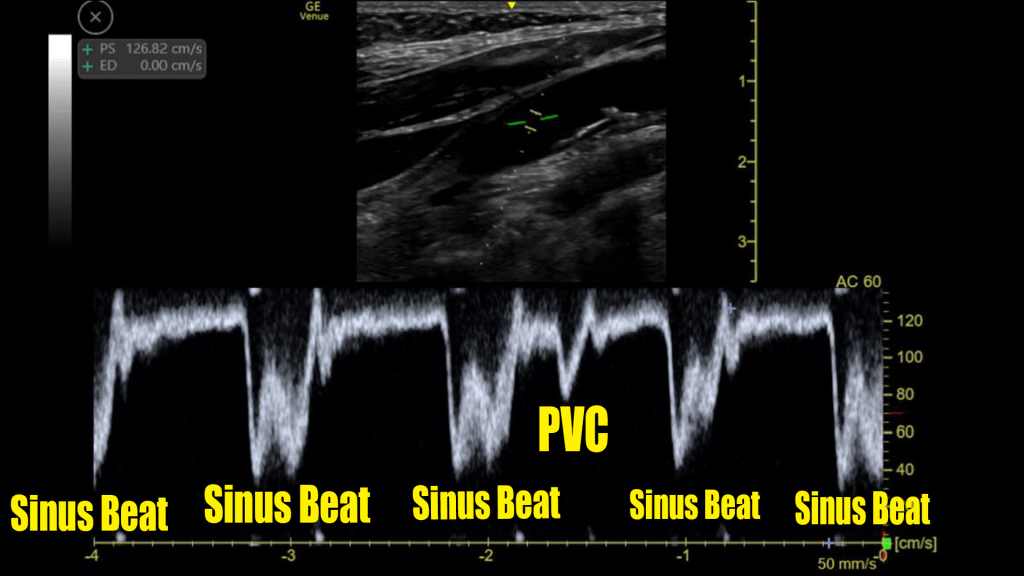
We see that the PVC does create a forward flow of blood that is measurable in the carotid artery.
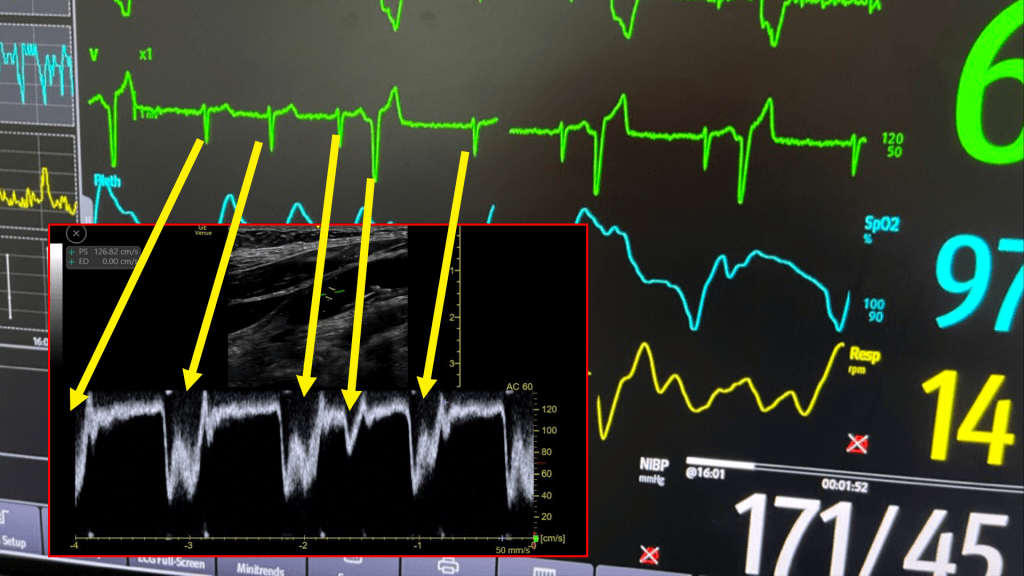
Does this mean anything?
Not really. But I’d brought it up in the last post, and it was driving me crazy. Now I’ve answered my own question, even if nobody else was asking. In ventricular bigeminy, the pulse oximeter (and my fingers on the radial artery) often do not pick up two beats. However, as we have seen here, the PVC does actually cause left ventricular contraction. It does not produce a palpable beat, however, because it occurs so quickly after the sinus beat that there is not enough time for ventricular relaxation (and the passive filling that goes along with it) to produce a meaningful stroke volume. I don’t feel that changes the fact that their peripheral tissue is essentially getting blood flow at the (lower) rate measured by the pulse oximeter. If the patient is symptomatic during these spells, that is probably why.
Now we know.
 Searcy EM