We have a handful of medicines that we administer by the “amp” (sodium bicarbonate, epinephrine, calcium chloride, and dextrose, for example). Clearly this is for simplicity as these are medications we use in emergent situations. That being the case, you may not spend much time thinking about the amount of medicine you are actually giving. Most have nice round numbers: D50 (50% dextrose), 10% calcium chloride, and although we don’t push this medicine by the “amp,” lidocaine comes in 1%, 2%, or 4%. But sodium bicarbonate comes as 8.4%. Weird. Why? Do you know?

First consider some units.
If you’ve ever looked closely at a basic metabolic panel in America you’ve seen that sodium, chloride, bicarbonate, and potassium are presented in the units of mmol/L.* Glucose, creatinine, BUN, and calcium, however, are listed in mg/dL. (Other countries use more uniform units.)
*We often refer to these ions, particularly potassium, in terms of mEq. Remember that when an ion’s charge is one, mmol and mEq are the same number and can be used interchangeably. Calcium has a charge of plus two, so it’s concentration in mEq/L would be twice its concentration in mmol/L.
Why the different units?
The short answer is I don’t know. We will leave it at that.
What does the ‘percent’ mean on the label?
“Percent” must be “something out of a hundred”. In the case of pharmaceuticals, the units are grams (of medication) dissolved in 100 ml of solute. 100 mL is a deciliter, and the phrase “grams per deciliter” does seem to have a familiar ring to it.
Notice that your lab reports serum glucose and calcium in g/dL (g/100 mL), which is the same unit as the “amp” of D50 or 10% calcium chloride. No units to convert. Easy.
So why is sodium bicarbonate the oddball?
As we have seen, laboratories report sodium bicarbonate in mmol/L. However, by convention, we label “amps” in percentages (g/dL).** So, there must be a conversion factor between the two.
Indeed there is. To convert from g/dL to mmol/L, we need to think back to college chemistry and find the molar mass of sodium bicarbonate. That means adding up the molar masses of sodium, hydrogen, carbon, and three times that of oxygen (NaHCO3). Take my word for it, it is 84 g/mol.

So, if the concentraion in the “amp” is 8.4 g/dL we do some math and convert to mEq/ml: it comes out to 1. The solution is 1 mEq/mL. How about that? It’s actually a very simple number.
Sodium bicarbonate is an oddball because the concentration is actually in mEq/mL.
Fun Fact…
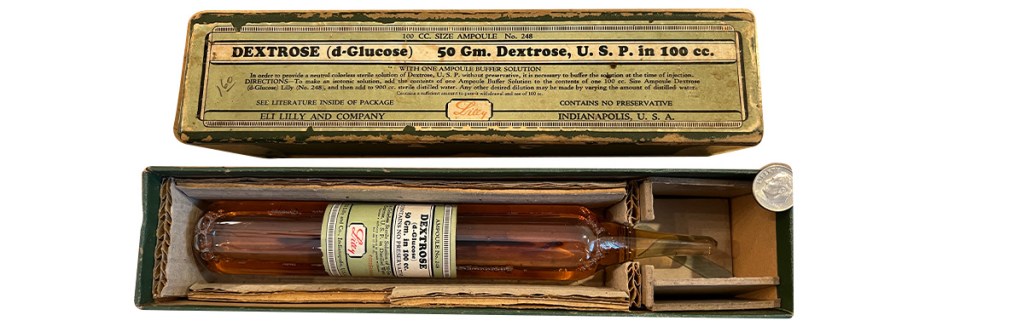
Maybe you noticed that I put the word “amp” in quotation marks throughout this post. That’s because these pharmaceuticals are not technically in ampules. Ampules are the all glass, single-use bottles whose tops you have to break and then use a filter needle to draw out the liquid. These things we refer to as “amps” – as in, “push an amp of D50” – are technically prefilled syringes, not ampules.
**Epinephrine has traditionally come in vials and prefilled syringes that label their concentration as a ratio rather than as a percent: 1:10,000 for example. This is confusing. The units reported are “g:ml”. So, a ratio of 1:100 is g/dL, just like everything else. I’ve found several sources1,2 that site the fact that the FDA has said that as of May 2016, concentrations could no longer be reported as ratios due to the confusion it causes.
 Searcy EM